
Category: Articles

  • Served Agency: Oregon Food Bank

    The primary mission of the Multnomah County Amateur Radio Emergency Service is to ensure that qualified amateur radio operators (AROs) are ready to provide communications support to organizations – served agencies – that have requested these services in times of emergency.

    One of our serviced agencies is the Oregon Food Bank. The following is an interview with the MCARES Oregon Food Bank Team Leader, Kiri K7KAH.

    Steve: Where is the OFB located?

    Kiri: We are stationed at the OFB HQ on NE 33rd in PDX, a couple miles from the airport. There are additional OFB locations in Washington County, Tillamook, and Ontario with radio equipment.

    Steve: How long has the OFB been a served agency of MCARES?

    Kiri: I believe we fired up in late 2013. Adam KF7LJH was originally the team lead. I joined as team lead when Adam moved into his current position in mid-January 2014. Essentially 2 years.

    Steve: How will your team support the OFB during an emergency?

    Kiri: Provide backup communications between OFB sites, and OEM and other agencies if there is a grid-down situation, or landlines are clogged. I envision most of the traffic will be passed relating to movement of food stuffs around the state between OFB sites. OFB operates in emergency situation under the national response framework. So whatever they are mandated to do under the emergency support function we would be helping passing traffic.

    Steve: Who are the OFB Team members?

    Kiri: Kiri K7KAH, Chris KE7OSH, and John KF7ZWX.

    Steve: How long have you been Team Leader?

    Kiri: Since January, 2014.

    Steve: What kinds of Ham equipment do you operate at OFB?

    Kiri: Each OFB site has a portable set that was put together by Garrett AF7RF and Dean (OFB liaison).
    UHF/VHF: Yaesu 8900
    HF: Yaesu FT897-D
    Commercial: 800 MHZ for county communications (Emergency use only)
    Antennas: horizontal dipole for HF, I don’t know the brand of VHF antenna.
    We have headsets, no desk mics, just the mics that come with the radios. No TNC.

    Steve: Do you have Winlink/Winmor capabilities?

    Kiri: Not yet.

    Steve: What are some of your operating challenges?

    Kiri: We are at a low point in the city, so sometimes getting to places over the hills on simplex can be a challenge. We also have challenges reaching our Ontario and Tillamook stations on HF when the propagation is bad. They are getting ready to install a massive generator at our location. We will have to see if that introduces any interference to our operations. When they test the generator out we will need to fire up the station, so that’s on the to-do list.

    Steve: Has the Team done separate training apart from regular MCARES drills?

    Kiri: I try to meet with Dean on a monthly basis to test the radios. We have done HF calls to Ontario a few times. Eventually we’ll want to get tests out to all the stations, if possible on a monthly basis. And get the rest of the MCARES team and OFB hams in on these meetings when possible. Our next big challenge is testing the Washington County location which has not been operated at all – hopefully some time in November.

    Steve: Are there other facts or statistics that you feel may be of interest to the general MCARES membership?

    Kiri: We need more people on our team, so if you are not on a team yet and you live in NE and you’re interested in food safety, movement, and volunteering with a great organization for a great organization, let us know!
  • A Well Trained Operator

    I have been exposed to ham radio since I was a child, but having only gotten my ticket a year and a half ago, I have a lot to learn and my perspective on using radios in emergency situations is still fairly fresh. As I have been learning, I have come across quite a few good articles about hams coming to the aid of others in times of trouble. Here in the Northwest, we only have to look as far as the March 2014 Oso mudslide in Washington, where hams played a crucial part in making sure that the communications network was solid and that information got where it needed to go. Of course the tragic loss of ARES/RACES members Jerry Martin W6TQF and Reid Blackburn KA7AMF (among many others) during the eruptions of Mount Saint Helens back in the spring of 1980 underscores the potential danger hams may face as well as the selflessness that is displayed by many who give their time and expertise to helping others stay connected.

    Since I joined ARES a little more than a year ago, I have had some pretty interesting conversations with friends about what we do and why something as seemingly arcane as ham radio would be so important. I have heard plenty of people claim that cell phone and Internet technology makes radios more or less obsolete, especially when you consider how much data is available online. I will readily admit that the availability of early warning apps and incident emergency management software is a great achievement, but when the networks go down, radios are still your best bet.

    It’s not just the radios though. It takes well-trained operators to make a system work. As ARES members, the mission is to get the message through by whatever means possible and whatever medium is employed. It is really the operators who make this such a critically important system. When we volunteer at public events, we are practicing the protocol and discipline that keeps the airwaves (and ultimately the mission) organized, clears out the confusion and perpetuates habits that may save lives when an emergency arrives.

    Of course, ARES does not operate in a vacuum. No matter where or under what circumstances we deploy, we find ourselves assisting and integrating with many other organizations. In my case, besides being a member of ARES, I am the ARO (amateur radio operator) for the Beaumont-Wilshire, Alameda NET (Neighborhood Emergency Team). If you are not familiar with this group, the NET program consists of around 2000 currently active volunteers throughout the City of Portland and operates under the auspices of the Portland Bureau of Emergency Management (PBEM). Our main mission is to provide immediate assistance in our neighborhoods in the event of an emergency. We are trained to do search and rescue, first aid and to set up communications as well as prepare for the arrival of professional responders. We also deploy to assist for community events and to help operate warming and cooling shelters during extreme weather events.

    As most of my team members are not hams, we depend on FRS radios as our means of radio communications for drills and deployments. For the past year, I have been running a net, prior to our monthly meetings in order to help train members on using their radios and to get them used to talking over the air. While participation has been fairly active, it is still only a 15 minute net, once a month so I have been seeking out ways to help the team learn some of the important aspects of radio use. Last year, Jeremy Van Keuren from PBEM was kind enough to send out a note from me to team leaders and AROs throughout the city, asking some questions about training and how they are overcoming issues relating to poor reception and such.

    The response was encouraging and enlightening. Many teams have taken time to map their areas and determine where the weak links are, and quite a few have instituted strong communication training components into their preparedness regime. I took this information and wrote up a guide for radio use to distribute among my team. It was a great exercise for me and definitely helped my team move forward, but it also opened up some good connections between me and the ARES people who are actively training NETs in radio use (Michael AE7XP, Helen KE7SCS, and John K7TY). I have collected the various guides and trainings out there and attended an excellent training given to the Irvington NET by John K7TY.

    This all points to one core point. If you are going to get good at something and commit it to that crucial “muscle memory” that we depend on in stressful times, you need good training and lots of practice. This ties in to our recent training in ICS 213 and NTS radio traffic handling. While I learned the use of both well enough to gain my ARRO certification last year, I find that spending time listening in and copying traffic on the NW Traffic and Training Net (6:05 PM every evening on the WORC repeater system) helps me to keep my skills honed. Learning how to use our radios to communicate has definitely helped our NET develop as a team and we have dedicated more time to actually getting people on air, practicing calling in and learning how to get the message across clearly and concisely. As our team is spread out quite a bit, we are also planning on taking some time to map out how our locations affect our ability to communicate. This is a work in progress and we will be on the lookout for ways to keep honing our skills so we will be ready and able to respond when the need arises.

  • What’s with Our Ham Radio Phonetic Alphabet?

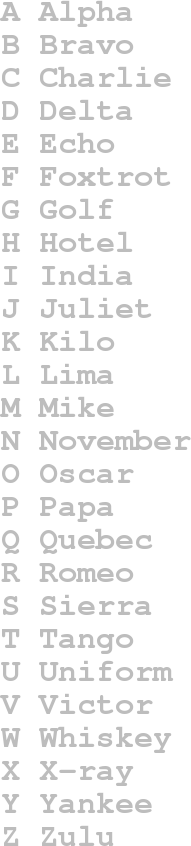
    One of the most elemental demands in effective HAM radio communications is correct use of the phonetic alphabet. All new hams struggle a little with memorizing which word goes with each letter. However, it may be interesting to step back and remind ourselves about the history of this phonetic alphabet and some of its unique characteristics and uses.

    So where did this phonetic alphabet we use come from? Called by its most formal name as the “International Radiotelephony Spelling Alphabet,” it originally went into development by the International Civil Aviation Organization (ICAO) in the early 1950s. That was in the context of that aviation organization’s recommendation that the English language be used in all aeronautical radio communications. However, one of the problems with English was that virtually one third of English letters, like B,C,D,E,G,P,T,V and Z, were virtually indistinguishable in low audio or scratchy communications. And, too, the ICAO would be recommending a phonetic alphabet that had to be pronounced and understood by a great number of non-native English speaking persons. After what was then described as hundreds of thousands of comprehension tests involving 31 nationalities, the ICAO formally adopted the alphabet we use in March of 1956. But ham use was not immediate.

    Given the work that went into it, the ICAO alphabet was slowly but surely adopted by a great many other organizations. Each time it took on names that associated it with these new organizations like NATO, FAA, various maritime organizations and the ITU (International Telecommunications Union). Indeed, the ITU, which governs all international radio communications, announced acceptance of the alphabet in its official publication Radio Regulations in 1959. Because of its relationship with the ITU, the phonetic alphabet was then officially a part of the protocols for communications generated by the American Radio Relay League (ARRL). In the final analysis, within a few years of its overall promulgations by the ICAO, this system of phonetic alphabet nomenclature had become, and continues today, the most widely used phonetic spelling alphabet used in radio telecommunications.

    The international origins and orientation of this particular ICAO phonetic alphabet has left it with some interesting peculiarities. How, for example, was it decided that the words would have no common theme, include one, two and three syllable words scattered at random, and contain a diverse mix like the names of two foreign capitals (Lima and Quebec), two dance steps (tango and foxtrot), both men’s and women’s names, and several words of more Hispanic than English origin (Romeo and Sierra)? Incidentally, until 1956 the phonetic alphabet recommended by ICAO only used predominately the names of countries and cities around the world (think: Madagascar, Uppsala, Gallipoli, Yokohama or Xanthippe) With its new phonetic alphabet however, ICAO paid great attention to the chance the word would be understood in the context of other words as well as in lengthy text. It is reported, for example, that “football” was better understood in isolation but that “foxtrot” was more comprehensible in extended communications.

    Also in recognition of its international origins and use, ICAO has suggested a pronunciation for many of the words in the alphabet that would not be recognized as Standard English today. Other adopting agencies have also adjusted and changed recommendations in pronunciation. Two words in the ICAO alphabet even have completely unique spelling so as to aid non-native English speakers to recognize how they might be pronounced (Alfa and Juliet). And the alphabet also recommends pronunciations to help native English speakers avoid producing sounds quite foreign to English. After listening to people curl their tongue deep to say the French sound “Que ..” part of Quebec, I think the ITU may have done it right with recommending a pronunciation as “KEH-BECK”

    Of course phonetic alphabets have a history in communications that go well before the ICAO (or its current permutations with ITU, FAA, NATO, and IMU). When some of us were growing up as Boy Scouts in the 1950s, we used one that was then standard for the US military. It started out: Able, Baker, Charlie, Dog, Easy, Fox, George …etc. Thankfully, a remnant of this phonetic alphabet still survives today. “Roger” was the word for “R” in those days and was the code abbreviation for “Received.” It would be awkward to say “Romeo” to indicate ‘Received” for many folks today. Check out http://usmilitary.about.com/od/theorderlyroom/a/alphabet.htm if you want to see all the different changes in phonetic spelling the US military has gone through over the years.

    Finally, it can be noted that different localities often introduce changes into the ICAO phonetic alphabet for quite understandable reasons. For example, it is reported that “Delta” is variously replaced by “Data”, “Dixie” or “David” at airports, like Hartsfield-Jackson Atlanta International Airport, that handle large numbers of flights by Delta Airlines. Sounds like a good idea to avoid confusion there.

    Hope this helps everyone to appreciate a little more the work that went into developing the phonetic alphabet we use in ham communication and maybe also to enjoy some if its unique characteristics.

    Bob KG7JKQ (KEH-BECK)

  • Mount Saint Helens Eruption and Amateur Radio

    As part of a Geology class at PSU, I finally had the pleasure of making the trip to the north side of Mount St. Helens to study the effects of the 1980 eruption. As a geology “hobbyist” and a member of ARES/RACES, my interest in the eruption is two-fold: how did the eruption occur and how did nearby communities deal with the event? As our luxurious tour bus meandered through the small town of Castle Rock, Washington, I had a moment of foreshadowing: an abandoned cinderblock shack, being overgrown by trees and blackberries with the words “REACT, CH 9″ painted in bright blue.

    Our first stop of the day was the Mount St. Helens Visitor Center at Silver Lake, where our visit started off with a 15 minute video of the eruption which focused on 3 of the lives lost in the event: David Johnston, geologist; Harry Truman, resident; and Gerry Martin, ARES radio operator. Although I was exhausted from the early morning adventure, I was jolted awake.

    Gerry Martin W6TQF was an amateur radio operator with ARES/RACES, volunteering for the Washington Department of Emergency Services. While geologist David Johnston was monitoring the activity from a ridge six miles to the north of Mount St. Helens on what is now Johnston Ridge, Gerry Martin was on the next ridge two miles to the north using the tactical callsign “Coldwater 2”.

    “Vancouver, Vancouver, this is it!”

    While David Johnston uttered those words which were never heard by the USGS office before his station went silent, Gerry Martin was able to provide a detailed report of the eruption and landslide to the WDES and stated, “The camper and the car just over to the south of me are covered, it’s going to get me too”. Then silence.

    There was a second ham radio operator nearby, Reid Blackburn KA7AMF, who was also a photographer for the Vancouver Columbian, stationed on a ridge even closer to Mount St. Helens. He was never able to get a transmission out.

    Throughout the eruption on May 18, a total of 300 Washington ARES volunteers passed over 3,000 messages including both health and welfare traffic and situational information as the lahar decimated the Toutle and Cowlitz river valleys.

    I was very glad to see that the story of these volunteers is not forgotten and is still being told at the St. Helens Visitor Center. It also gave me an opportunity to introduce ham radio and ARES to a few classmates.

    The Mount St. Helens Visitor Center is located 5 miles off I-5 on Highway 504. They are open seven days a week from 10 AM to 5 PM, and admission is $5.