Multnomah County ARES is proud to provide radio communications services for the Disaster Relief Trials Portland for the fifth year in a row. This exciting event is a mixture of bike race, disaster relief exercise, and emergency preparedness fair. The event takes place on Saturday, October 22 from approximately 08:00 to 17:00. The main event will be held at the University Place Hotel in downtown Portland, and there will be several checkpoints scattered around the city.
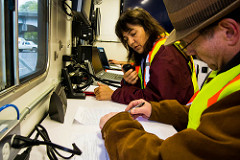
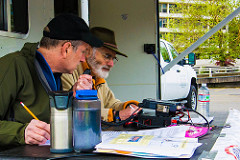
We would love to have your help with this event! We will need radio operators for net control and logging in the communications trailer, and reporting rider arrival times from the checkpoints. We will be pairing up less experienced operators with more seasoned volunteers, so don’t worry if you haven’t worked many (or any) events before.
If you would like to participate, please fill out and submit the volunteer registration form so that the communications organizers can best staff the available positions.
UPDATE: Volunteer registration is now closed, to allow the event communications team sufficient time to finalize position assignments and other details before the event.
Have you been wanting to build your own radio go-kit, but aren’t sure where to start? Join us at our September meeting and get some ideas! Robert WX5TEX will host a presentation on radio go-kit construction and design, and will also introduce the new Multnomah County ARES digital go-kit.
The general meeting and training will be held on Thursday, September 22, from 19:00 to 20:30 at the Portland Fire & Rescue Training Center at 4800 NE 122nd Avenue in Portland.
From 18:30 to 19:00, we will host a discussion for new members and those who want to brush up on some of the basics. Come with your questions!
The July meeting will be our annual Go-Kit Show and Tell, and we encourage everyone to bring their field operating gear and ideas to demonstrate and discuss. We’re stepping things up a bit this year, showing off the Multnomah County ARES communications trailer and hosting a pot-luck picnic and barbeque.
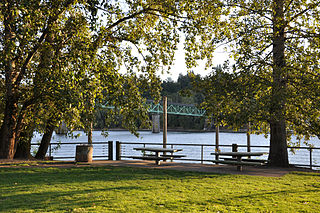
The meeting will be held on Thursday, July 28 from 7 PM to 9 PM at Sellwood Park in Portland. We have reserved Picnic Area I, which is at the north end of the park, near the parking lot, and we’ll be starting to set things up around 6 PM. There will be room around the picnic area to show off your go-kits (bring a camp-style table if you’d like; just don’t plan to stake anything into the ground).
Thanks to individual donations we collected at the last meeting, Multnomah County ARES will be providing burgers, hot dogs, sodas, plates, and utensils for the picnic. Members are encouraged to bring their go-kit, a side dish to share, their family, and anyone they may know who is interested in Amateur Radio.
It is nearly time once again for the annual Walk MS event in Portland. Multnomah County ARES is honored to have been asked by the National Multiple Sclerosis Society to provide communications support for their event again this year. In years past this event has been well regarded as a training and public service event for the Amateur Radio community.
The event takes place on Saturday, April 23 from approximately 08:00 to 13:00, and is held in downtown Portland along the Esplanade and in Pioneer Courthouse Square.
UPDATE: Due to amazing volunteer turnout, we have been able to staff all event communications positions much earlier than expected. We have therefore decided to close volunteer registration early, on April 1. This will allow the event communications team more time to finalize position assignments and other details before the event.
The 2015 Portland Disaster Relief Trials (DRT) event on October 17 was a stunning success, and the DRT event organizers were very pleased with the services provided by Multnomah County ARES! We had a lot of technical challenges in front of us this year, with the inclusion of not one, not two, but THREE digital modes we’ve never used before in an event, and I’m very happy to report that they all worked extremely well!
Winlink proved to be an efficient means of transmitting rider reports, and supplied the leaderboard volunteers with a constant stream of accurate rider information, while allowing the voice net to concentrate more on tactical traffic.
EasyPal worked flawlessly, providing the PBEM communications trailer with nearly two dozen high quality still images from the checkpoints. It was very exciting to be able to see, in near real-time, photos of the action out in the field. A special thank you goes out to Adam KF7LJH and Nate N9VCU for making that all happen.
The Broadband-Hamnet wireless mesh network link between checkpoint 4.1 (Water Feature) and the PBEM communications trailer worked amazingly well, and allowed us to display a real-time video feed from the checkpoint. Many thanks to Michael AE7XP for supplying the hardware and making it all work.
The event was a huge success not just because we were able to provide the rider reports needed by the DRT staff, but also because we gained valuable experience with digital modes that are new to many of us, and demonstrated their value and potential use in disaster response. Thanks to all the volunteers who made this possible. I hope you will consider volunteering for the DRT Communications Team again next year!
Brian Cochrane – KE7QPV DRT Communications Organizer
Greetings, members! The role of Web Manager transitioned from Bruce N4PDX to me in December, 2014. I would like to thank Bruce for all his previous work, and for helping me take on his duties. Since the transition, I have been working hard to update and add new content to the website, and expand our use of Facebook, Twitter, and Flickr.
The website now has a Training tab, under which you will find details about our training plan, training calendar, certifications, traffic handling, ICS courses, and licensing.
Two other notable additions are under the Resources tab. The Nets section lists several area nets which will be of interest to both new and experienced ARES members. The Equipment Manuals section contains links to manuals for radios and other equipment at our served agencies. The calendar has been updated with meetings, drills, nets, events, and volunteer opportunities, as well.
Robert WX5TEX created the Multnomah ARES / RACES Facebook page to help get the word out about our Trailer Project fundraiser campaign. The page drove additional traffic to the campaign, and was directly responsible for donations totaling $275! It has surely proved to be a valuable asset. We now have 69 followers on Facebook, and each week brings more.
We are now using Flickr for organize our photos from meetings, events, and exercises. These photos are an excellent tool to show people what we do, and can be used on the website, in social media, and in training and promotional materials. Several members have contributed and we now have over 160 photos sorted into albums. Please take some time to browse through the photos and let me know if you have any to share.
Some members have voiced concern over our adoption of Facebook as a communications tool, fearing it might replace existing communication methods. Rest assured, the website and email distribution list will remain our primary means of disseminating information to Multnomah County ARES members; we have absolutely no intention of replacing them.
While participation in the email list is only open to active and supporting members, social media provides opportunities to demonstrate our role and value as emergency communicators to a wider audience – people who are not members and who may not even be familiar with ARES or Amateur Radio.
Our Facebook page, Twitter feed, and Flickr photo albums are public, so you do not need to register with those services to view the content. If you do have accounts, however, please consider Liking/Following us to help increase our exposure.
I have many varied interests and hobbies – if you can call an ever-growing pile of unfinished projects a hobby – ranging from physical sciences, electronics, computers, radio, and metalworking, to cooking, brewing beer, traveling, and studying languages. I have a bad habit of focusing very intensely on one or two areas for a while at the expense of others, and then switching when something else catches my attention – hence the unfinished projects. While it doesn’t (directly) involve cooking or brewing beer, it seems ham radio may be the closest thing I’ve found to pull my varied interests together (though I have some ideas rattling around that involve computers, electronics, and brewing).
I’ve been interested in electronics since I was a kid. My dad was an industrial electrician and brought home lots of old electronics bits for me to investigate, though I must admit that most of my self-directed “investigation” involved more disassembly, desoldering, and sorting of components into parts bins, than learning and applying electronics theory. I do recall one particularly illuminating experiment I performed around the age of 8, which involved an electrolytic capacitor and an AC wall socket. See, I understood that capacitors would store a charge when connected in parallel with a DC source, but failed to grasp, until that moment, how they behaved in an AC circuit. A shower of sparks and a tripped circuit breaker taught me a valuable lesson or two.
All throughout my childhood, I maintained that same curiosity about electronics, but lacked an end to the means – a goal to which I could apply the concepts I was learning. I had books full of amplifier and power supply schematics, but what could I amplify? What would I power? I think all along I needed amateur radio to help guide and focus my interests, but I wasn’t even aware of its existence. The addition of a new family member in my middle school years – an 80286-based computer – sent me in a whole new direction, learning about programming, operating systems, and digital communications, which has in turn led to employment in technical support, software quality assurance, web development, system administration, and telecommunications.
Sometime around 1995, in my college years, I learned of amateur radio. I found it interesting but didn’t know anyone who was licensed, and didn’t have the time or money to pursue the hobby. When the Great Coastal Gale of 2007 cut off all communication with family on the southwest Washington coast, I felt helpless and thought again about amateur radio. I decided that earning my amateur radio license and getting trained in providing emergency communications would be one way I could make myself useful the next time a disaster struck our region. I studied hard and got my Technician license in January, 2008, then bought a J-pole and an old, used Kenwood TM-773, which I nervously sat in front of many a night before mustering the courage to key the mic and check into the Portland Amateur Radio Club’s Monday night net.
I went through the Portland Neighborhood Emergency Team training in the Winter of 2009, made my first long-distance QSO, with W6YX, via the U/v FM repeater on board the International Space Station, then upgraded my license to General. I checked into the occasional FM 2-meter net, and attended an ARES meeting or two, but otherwise remained fairly inactive until I attended the NET/CERT/ARES “radio tour” in May, 2012. That got me motivated to start volunteering for event communications, and by the end of the year I had worked at least 8 events and a fire station go-kit exercise or two, and I was hungry for more. Since then I have become more active in Multnomah County ARES, have helped organize communications for Walk MS and the Disaster Relief trials, and became the team leader for the PBEMECC team.
In addition to emergency communications, I am also interested in amateur satellites, digital modes, software-defined radio, and, thanks to my success in the December 2013 MCARES contest-style drill-from-home and encouragement from K7ATN and others, I have a growing interest in VHF+ contesting. Maybe someday I’ll get on HF…