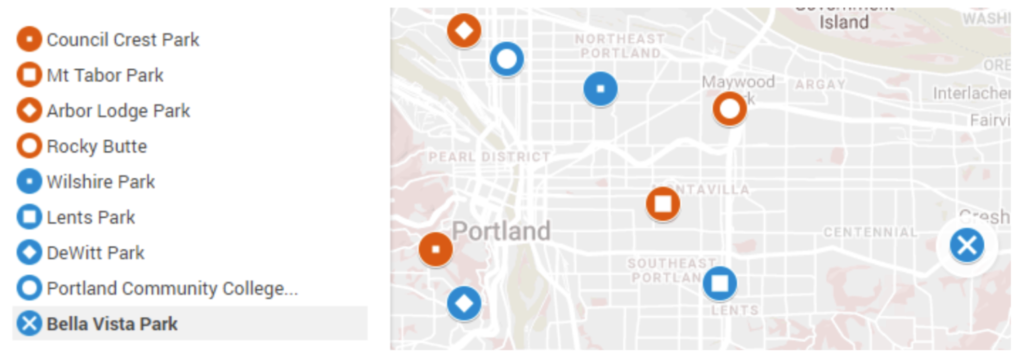
The March 7 “Cascadia Slips a Bit” field exercise was a great success. We had 45 members willing to brave the cold and rain to send Winlink messages from all parts of the county. The digital go kits got a good workout and the quad gateway (Frankengate) continues to prove that it is a valuable asset.
Nine field stations were deployed for this exercise.
This exercise was done to hone our ability to send and receive local Winlink without the internet. The VHF to HF gateway allows us to also send Winlink messages out of the area to other parts of the country where internet still works.
Thanks to everyone who participated and a special thanks to the teams that deployed early to set up special equipment.
We received safety vests as part of the last UASI grant so if you need a vest or your current vest has seen better days let me know. I will bring one to the next meeting for you if you email me. We have a limited supply and hope to supply vests to our new members when they complete their ARRO training.
The new digital kits (photo above) are almost complete! The new design will make the kits lighter and easier to pack around. The batteries have been upgraded to two 35AH batteries for a total of 70AH for each kit. You can see the whole kit at the next ARES meeting.
Welcome to our newest members, Robert KI7KYE and John KI7YBL, both on the Delta Team. We now have 109 active members. We logged an amazing 476 volunteer hours in February – great job, everyone!
The Multnomah County ARES website was migrated to a new hosting provider this evening. No problems were encountered during the migration, and all testing of the site has been successful. If you do notice any problems, however, please send an email to webmanager [at] multnomahares [dot] org and I will investigate.
We will have a field drill involving all MCARES teams on Saturday, March 7 from 09:00 to 13:00. All MCARES members are asked to participate if possible. Your team leader should be in touch with you prior to the drill, to discuss location and any other details specific to your team’s role. Please be sure to thoroughly read the drill guide and ICS-205 before the drill, and direct any questions to your team leader.
Having experienced a few earthquakes while living in San Jose and realizing Portland, too, was located in earthquake country, Rochelle took a weekend PCC class on preparedness. The one thing she took away was that ham radio would be the only way to communicate during and after a disaster.
A simple search pulled up McARES, and so the journey began with a new volunteer organization. She has a Yaesu VX-8R handheld and a Kenwood D710 at her home station that runs a Winlink gateway.
“It’s impossible to be bored – especially on the Mike team! There is always something to learn and something fun to do with ham radio.”
In fact, Rochelle is now the new coordinator for Connected, the MCARESnewsletter. She hopes you enjoy the new format!
We welcome our newest members: Steve KJ7JBC who joins the Delta Team and Teddy KJ7IJR who has joined the Bravo Team. The membership roster was trimmed in December to reflect inactivity by some members so we are starting the new year with 103 active members.
The newsletter has a new, refreshing look for 2020! The MCARES “Connected” newsletter was established in July of 2013. Since then, Vaughn Lewis AC7HO has formatted the content into newsletter format. We can’t thank Vaughn enough for all his years of service!
A new decade brings a new look for “Connected.” Rochelle AE7ZQ is taking over the job with new ideas and formatting. Thanks, Rochelle!
Grant equipment update: With the help and support of Multnomah County Emergency Management two UASI grants have been funded for eight additional digital go-kits and personal protective equipment (PPE) for all of our members.
The radio go-kits will be built with a new design that will make them lighter and even more portable and flexible. The PPE kits will be available for distribution at our January 23rd meeting. If you have completed your ARRO basic training you are eligible to receive this kit. These bags contain safety items you will need for deployment. I was going to list the items but thought a surprise would be much more fun!
I’m so glad to be entering a new year with the state’s best radio crew. I would especially like to thank the leadership team for spending an entire Saturday in December to chart our path through the new year. As we go forward in the new year a lot of the same skills and themes from before will be returning. There are also minor tweaks to improve on the strong operating foundation we have built over the last several years.
Our main focus areas will continue to be digital field operations (Winlink from temporary locations) and building our technical and operation knowledge and skills. We have some new equipment, and a slight revision to the existing field kits. By late spring, I expect a new portable asset to be deployed (the Spartan trailer). Our exercises and drills will attempt to repeat and cement our basic skills, while allowing room for growth as well.
Later in the year we will have our campout, which I have aligned with the “Worked All Europe” DX SSB contest. I hope to include a tailgate swap meet element to the August go kit show-and-tell. Right off the bat in January there is Winter Field Day on Jan 25th and our first drill will be a pajama drill on February 1st. I hope to see everyone at the January general membership meeting for a discussion of SOP revisions and further discussion of the year ahead.
Thanks to all, and I am sincerely looking forward to it!
Welcome to our newest members! Sue KG7ALI joins the Alpha Team, Catha KJ7FWT joins the Bravo Team, Jon KG7HVA joins the Delta Team, and Richard KJ7FBH joins the Echo Team.
The annual ARES raffle continues at our monthly meeting. We hope you can find something that you would like to have. Tickets are $5 and proceeds are used to purchase food items for our go-kit show and tell and Field Day BBQ’S. The funds are also used to purchase propane for the ARES trailer. You can see the raffle items at the back tables at the ARES meeting where tickets are also sold. The drawing will be at our August Meeting and you will not need to be present to win!
We’ll have a full training on this topic at the September meeting. In the meantime, here is some food for thought. As emergency amateur radio operators, we are called on to pass information during crises/disasters. Our roles don’t include a lot of decision making. Exhale.
The bare minimum here is to show up, team well, and get the job done. Know how to use your equipment, where to be, who to connect with, and who is in charge. If any of these concepts cause you angst or raises your blood pressure, that’s your first area of focus. Spending some time and energy there will increase your confidence and reduce your stress in an actual event.
Here are some basic pointers for managing yourself as the pressure increases:
Take care of your body. Make sure you have ample food and water as well as clothing matched to the environment. Get adequate rest before, during, and after.
Know how to operate your equipment. If you don’t or you’re having an off day, you can still be helpful. Volunteer for a role you feel more comfortable doing.
You need to be able to accept and follow directions, given directly.
Know when to take a break (self or other directed), when to ask for help, and when to offer.
SLOW down. Equipment fails; you don’t have to.
Don’t ask “what if?” If you can’t avoid this common pitfall, try changing it to “how?”
Most people are prone to increased stress in stressful situations. It’s not rocket science, it’s life preserving. It’s your job to know and work with your triggers in stressful events/situations. Sharing these with your team lead in advance can assist with assignments and practice opportunities during drills.
Teaming well and taking care gets the job done.
In September we’ll go over both in-the-moment and long-term strategies/concepts for maintaining calm during stressful events.