Author: Nathan NA7EE

  • From the EC’s Desk: Field Day

    ARRL Field Day

    I hope everyone finds themselves safe and healthy as they read this! June is almost upon us, which is normally our time to gather for field day where we share tight quarters, communally sup, and greet each other warmly. Unfortunately, epidemiological prudence demands a different tack. I am bummed, but I hope we all can make the most of the weekend of June 27 nonetheless.

    Since we cannot meet in person, I am encouraging everyone to execute Field Day by operating field stations in their own backyards or physically-distanced location of their choosing. Given the number of MCARES operators, there should be contacts to be made locally even if VHF FM voice is your only operating mode. Since contacts count for points on each different band, this could also be a great excuse to expand into 6m operations if you’re interested. The sheer number of folks on the air can make the magic band seem alive for long distance contacts! In the spirit of the event, we should all strive to operate via auxiliary power (batteries or other) as well.

    The gist of the operating on Field Day is a contest format with a standard exchange. Since there are usually so many stations operating, there is often great leeway granted to newer operators during Field Day. So don’t stress about the radio operations themselves; dive in and have fun. The best place to start is the ARRL’s Field Day page. A YouTube binge for Field Day videos is also a great way to start if you’re completely unfamiliar.

    The rules are somewhat in-depth, so if you have questions after you review them, I encourage you to bring them to the June general membership meeting. Hopefully we can address everything at that time so everyone can operate with confidence. I hope to hear a lot of local “One-Echo-Oregon” stations on the air this Field Day!
  • New Year’s Greeting from Nate

    Happy New Year, MCARES!

    I’m so glad to be entering a new year with the state’s best radio crew. I would especially like to thank the leadership team for spending an entire Saturday in December to chart our path through the new year. As we go forward in the new year a lot of the same skills and themes from before will be returning. There are also minor tweaks to improve on the strong operating foundation we have built over the last several years.

    Our main focus areas will continue to be digital field operations (Winlink from temporary locations) and building our technical and operation knowledge and skills. We have some new equipment, and a slight revision to the existing field kits. By late spring, I expect a new portable asset to be deployed (the Spartan trailer). Our exercises and drills will attempt to repeat and cement our basic skills, while allowing room for growth as well.

    Later in the year we will have our campout, which I have aligned with the “Worked All Europe” DX SSB contest. I hope to include a tailgate swap meet element to the August go kit show-and-tell. Right off the bat in January there is Winter Field Day on Jan 25th and our first drill will be a pajama drill on February 1st. I hope to see everyone at the January general membership meeting for a discussion of SOP revisions and further discussion of the year ahead.

    Thanks to all, and I am sincerely looking forward to it!

  • All-Team Drills

    We will be running training exercises for MCARES on Sunday, July 21 and Saturday, August 17. I hope for maximum participation on these dates, as the plan is for full drills to maximize training value. That said, I do not expect everyone to make both dates, although it would be great to participate in both if you can.

    For now, I just wanted to give everyone a heads-up for these upcoming drill dates.

  • From the EC’s Desk

    Grounds and Grounding

    There has been a lot of activity in the station building front in MCARES over the past few months. As I receive stories and reports I am greatly encouraged by everyone’s willingness to jump in and build a better radio station. One of the main topics of concern folks have when installing a new radio station is proper grounding. There is considerable confusion and strong feelings over this topic. I cannot hope to clarify the technical aspects of station bonding and grounding in a newsletter setting, but I do want to make sure that everyone is looking in the right places and asking the right questions when they consider their station grounds.

    There has been a lot of activity in the station building front in MCARES over the past few months. As I receive stories and reports I am greatly encouraged by everyone’s willingness to jump in and build a better radio station. One of the main topics of concern folks have when installing a new radio station is proper grounding. There is considerable confusion and strong feelings over this topic. I cannot hope to clarify the technical aspects of station bonding and grounding in a newsletter setting, but I do want to make sure that everyone is looking in the right places and asking the right questions when they consider their station grounds.

    First off, the best way to get the right information is to research the situation oneself from the appropriate resources! MCARES is adamant that the ARRL technical publications are the best place to find information that has been vetted by competent engineers and will lead to safe and effective station construction. The two best publications are Grounding and Bonding for Radio Amateur and The ARRL Handbook. Additionally, The ARRL Antenna Book for Radio Communications has very good in­-depth information regarding RF grounds and their effects on radiated signal.

    When one begins their shack, consider the four types of grounding/bonding that are part of proper station design. These are:

    • Electrical Safety Bonding
      • The ground that provides the path for over­current protection and provides chassis shock protection.
      • This is the third prong / green wire in your house distribution
    • RF Ground
      • It is important to keep the shack equipment at the same reference potential to avoid current flows or potential differences that can affect the operation of modern equipment.
    • Chassis Ground
      • These are the connections we think of for grounding inside the shack, the individual chassis connections to a great, fat ground bar that makes its way to a good earth ground.
      • Bonding of equipment to prevent RF flow between them can be difficult, so make sure your ground strap setup is as clean and short as possible.
    • Lightning Dissipation
      • The design of these systems can be complicated; make sure to review your desired results before implementing lightning protection. Again, review the appropriate technical references when you go to set up your operating station, and stay away from QRZ and eHam forums; you’ll find too much time there will make you want to give up on grounding altogether.
  • From the EC’s Desk

    Happy New Year, ARES!

    I hope everyone had an enjoyable holiday season. Now that the year has turned over, it’s time to get back into the swing of things. The leadership team has been working over the last month to put together a great plan and operating calendar for the upcoming year. To get the year off to a fast start, we will be participating in Winter Field Day as a unit for the first time.

    The training at the general membership meeting on January 24 will be on Winlink, to get us ready for our next drill on Feb 9. We felt last year’s drill from home using the Winlink system was a valuable experience, so that format will be duplicated for this drill with the addition of a resource net.

    The annual survey indicated you wanted more operating time so that is one of the key drivers of ARES this year. We all love to operate and doing so as often as possible is important for remaining sharp as a unit. We have forgone two-team drills this year in order to concentrate on drills as a full ARES unit. The goal will be to have some form of event members can participate in each month. This is not to say that we need everyone at every drill or event, but there should be more than enough opportunity for everyone to remain active.

    Coordinating an operating event or drill for the entire unit is a big lift, planning-wise. Thanks to all those who expressed interest in this task in the survey. We’ll work on incorporating those folks as we proceed.

    There are so many items I’d love to cover here, but instead I will take a large chunk of February’s general membership meeting to review continuing operating strategies and our upcoming year. For now, please review your kits, make sure your Winlink Express applications are up to date, and I look forward to seeing you all soon.

  • MultCoARES Field Day

    For those unfamiliar with Field Day, the ARRL explains:

    Every June, more than 40,000 hams throughout North America set up temporary transmitting stations in public places to demonstrate ham radio’s science, skill and service to our communities and our nation. It combines public service, emergency preparedness, community outreach, and technical skills all in a single event. Field Day has been an annual event since 1933, and remains the most popular event in ham radio.

    This outing is the largest event for radio groups interested in field operations. This will be the first year that Multnomah ARES will be operating independently for this event. It’s a big deal for us, as it is pretty rare that we operate and perform outreach over an entire weekend. I will attempt to outline the broad plan here, especially for those who have not operated during Field Day before.

    Multnomah ARES has extended an invitation to the Portland NET AROs to operate with us for this event. We will be operating from Saturday Morning on June 23 until Sunday Morning, June 24.  We will need to loft the antennas and set up the stations before the operating commences. I plan on performing these actions on Saturday; no pre-staging on Friday will occur.

    We will be operating from the picnic shelter at Willamette Park (off Macadam Ave). Our operating location was chosen for the large amount of foot traffic – the main goal of Field Day is outreach! I have tested Willamette Park for RF noise and skywave propagation (sufficient topographic clearance for takeoff angles). I was able to get contacts in Texas, Arizona, the East Coast, and Japan from this site, so I’m sure that our radio operations will be successful.

    We will be operating two stations for points, a GOTA station, and potentially a VHF station during the event. Setup will be interesting, and require some forethought. We are not allowed to sink stakes in this location, the area is somewhat cramped for large antennas, and the parking near the picnic shelter is metered and limited. That said, there is permanent plumbing, shore power, tons of passers-by and a beautiful view of the river. We’ll work through the difficulties and leverage the positives of the park.

    We will have a lot of work to do to make this event a success, but we have a ton of awesome and motivated folks in our radio unit. The leadership team will be reaching out for assistance, but many hands will make light work. Stay tuned for updates, and I hope to see everyone on June 23!

  • Mars Attacks, the Sequel (Fall SET)

    I would like to start out with a big thank you to everyone who participated and volunteered 140 personnel hours to the Fall Simulated Emergency Test (SET).

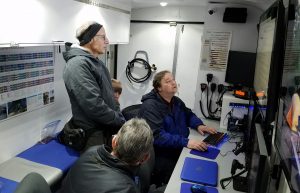
    We successfully executed operations from three stations on Saturday, October 16. Adam KF7LJH and Deb KK7DEB led the operations from the trailer (N7MCU) at Scouter’s Mountain. Robert WX5TEX was in charge of the county station at the Donald E. Long Center (JJC). Nathan N9VCU operated from Kelly Butte. Thanks to Metro, Multnomah County, and Portland Bureau of Emergency Management/Portland Parks for providing access to these great locations for our exercise.

    Thank you all for taking our safety training seriously, and to Deb and John KI7LYP for procuring the hard hats. Masts were raised at Scouter’s Mountain and Kelly Butte. The Kelly Butte mast operation was somewhat different than normal. Normally the masts we use are either the nested push-up style or aluminum style with the large tripod. At Kelly Butte we used a 40ft mast that was assembled to full length on the ground and then raised to the vertical position. We used 7 personnel to achieve this lift, and were able to do so safely. We learned a few things in the process, and I will cover those at the general membership meeting. Potentially another 1,000 feet of line and a come-along may make this a one or two person operation.

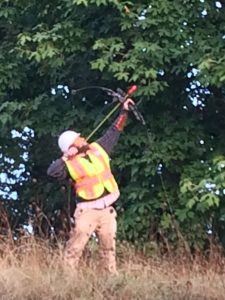
    Additionally, Martians were able to make off with the arrow your fearless EC has used to loft antenna lead-lines in the past. This has led me to swear a vendetta against their entire planet. As soon as Elon Musk can provide reasonably priced accommodations, I’ll take the fight directly to them.

    Voice communications on HF were extremely poor from the JJC. Kelly Butte is a very quiet operating location (low RF noise) and we were able to make some HF contacts. The bulk of Multnomah ARES’ operating successes were via Pactor. Although the HF Winlink nodes were busy, the low S/N needed for Pactor to work made a great difference at the power levels we normally run. Kelly Butte also was able to effectively pass NTS traffic through the Metro area. This included the ability to hit many VHF repeaters in neighboring counties. Word on the street is that Lynn Burrell had a grill going in Washington county, making the operators on this side of the hills salivate. Multnomah ARES normally has the grilling game on-point, so I’ll avoid letting down our field teams in the future!

    Again, thanks to all the operators who made the SET such a great time. I may have had more fun than any drill in the past few years. I’ll try to hide the ICS-214 from the Kelly Butte crew from judgmental eyes, as it shows N9VCU cared way more about antennas, masts, and Pactor modems than complete paperwork, but all in all a great success!

  • From the EC’s Desk

    In ARES we use many digital forms of communication. Primarily we use Winlink with packet TNCs, of course, to exchange email over radio. Soon (with this month’s training at our regular meeting) we will start to introduce sound card modes to our operations, using a digital radio interface and programs like MMSSTV and Fldigi to send text and images that way.

    But we get a lot of questions about “digital voice” these days. Which technology is MCARES going to pick from D-STAR, DMR, Fusion, etc. and recommend to the membership? The short answer: none at this time.

    The MCARES leadership team has made the decision not to incorporate any of the digital voice modes into ARES operations at this time, nor formally recommend any to our membership.

    The current Multnomah ARES standard for voice is analog and will remain so for the foreseeable future. We came to this decision after reviewing the results of the membership survey, speaking with local repeater operators, and discussions internally with some of our technically minded members. Some of the key factors in the decision included:

    • The most important characteristic of ARES radio operations is compatibility; any certified ham radio should work in an incident.
    • Many of the advanced features of digital modes are repeater-dependent.
    • No huge benefit to digital voice over analog voice on simplex (although digital data modes do hold future promise).
    • No critical mass: The few MCARES members with digital radios are using pretty much all of the available technologies.
    • A number of strong opinions: Some members feel strongly about “their” choice, and we’ve got at least one of those for each digital technology. Making a decision is going to be a little bloody.

    In summary, the leadership team doesn’t feel the new digital voice modes provide enough value to start integrating them into our regular operations yet or encouraging their adoption by the membership. But we encourage all members to explore and experiment with these digital voice modes because the day we’ll want to start leveraging them is not too far ahead of us.

    We do note that Yaesu Fusion has by far the largest installed base of repeaters in the area. D-Star has the largest base of radios, however. And while the DMR contingent is growing, it’s got the smallest level of adoption of all the ham radio digital modes at the moment.

    Thanks to all those who provided feedback during this decision process, and for your understanding as we work through technical and operational issues such as these.

  • From the EC’s Desk

    As we near the end of another successful year, I wanted to take the opportunity to thank all of the members that make Multnomah County ARES possible. Currently there are in excess of 70 active members in Multnomah County ARES. It takes us all to be a well operating unit.

    This past year we have seen our operating skills and abilities grow by leaps and bounds. Thanks to the efforts of our membership, the trailer project has gone from a dream to being deployed on multiple training and operating occasions. This new tool will allow us to perform control and relay functions free from the shortcomings of our brick and mortar operating locations. In October, during the Disaster Relief Trials, we operated both a voice net and three different digital modes (video/still imagery/Winlink) from the field simultaneously. This included over six field stations and two mobile operating trailers coordinating the efforts of our radio operators. I was so impressed by your abilities during that event that I am ecstatic for the future.

    Regarding our path forward, I have met with the Multnomah County Emergency Management Director, Chris Voss, and the Operations Manager, Alice Busch, and our directions are clear. We are to grow our ranks so that we can operate as many field deployable digital teams as possible. This will require a renewed recruitment and training effort. The leadership team has created the training outline for next year, and I’ll share details at the January meeting.

    On the recruitment side of the house, we need to spread the word about our organization and mission. If you know anyone that would be a good fit with us, please encourage their participation. We are one small part of the massive task that is preparing Multnomah County for disaster, but I am confident in both the vision of our Emergency Management team and in our abilities as operators, and I will seek to provide the trained operators that the County Emergency Management team has asked for. Here’s to a great new year of growth and development!

  • October 10 Exercise Scaled Back; Marathon and DRT Prevail

    It was decided at the leadership meeting that we will minimize our participation in the statewide exercise on October 10. We will only activate and staff the County ECC for this exercise. The team will handle the Winlink traffic from the State ARES/OEM. The ECC team will be contacted by team leader Deb to staff this.

    The exercise activities requested by the state ARES leadership involve field deployment, which we have done already fairly extensively this year. We feel it is too much to ask of you to devote three weekends in a row to ARES. It is more important and more valuable to your training and to the community that we put our effort into providing communications for the Portland Marathon the week before the exercise and the Disaster Relief Trials the week after.

    The Portland Amateur Radio Club coordinates communications for the Marathon and Multnomah ARES coordinates communications for the Disaster Relief Trials. This is where we need to concentrate our efforts and our volunteer hours in October. Both of these events are fun to work and provide very different communications and radio experiences. We will be using interesting technologies for the DRT with APRS, EasyPal (Photos), HSMM (high-speed data), and field VHF Winlink.

    Please sign up for one or both of these public service events. We need your help!